Don’t trust a teacher who…
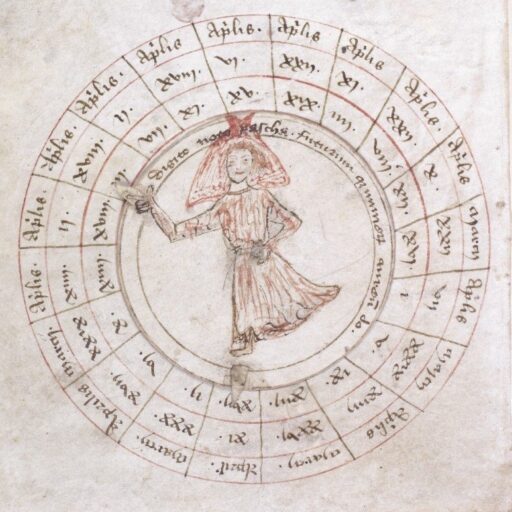
A few weeks ago, I set out to learn something about volvelles, a legacy of the medieval period consisting of moveable paper or card circles that rotate to expose or conceal specific information. It isn’t really an exaggeration to call them medieval apps. Some of the most beautiful volvelles allow a reader/user to calculate distances (using trigonometic calculations) or star positions, or simply to literally see moon phases change as one moves a pointer around the circle to the current date. I wanted to look at some “real,” that is, medieval volvelles, and Chat GPT obligingly shared the location of several well-known examples at the British Library, the Lambeth Palace Museum and the Science Museum. When I shared my interest in making a volvelle of my own, however, it all went a bit wrong.
Art education may not be the ideal preparation for conventional “success,” defined as the acquisition of money, status and security. But as someone who taught in art colleges for a long time, I can say that we steered students toward a reliance on their own judgement. The results are impossible to measure, but they are, I think, critical. We made all kinds of suggestions, facilitated the learning of new skills, opened whole categories of thinking and dreaming that were almost certainly new to them. We asked them to examine, explore, experiment; we did not tell them what to do.
When Chat GPT told me which manuscripts would be most important for me to see, I could hear the pompous, self-important, intrusive tones of a disembodied authority, a stark contrast to the human voices of students and teachers, exchanges that recognise and respond to shared experience.