What’s a bevatron?
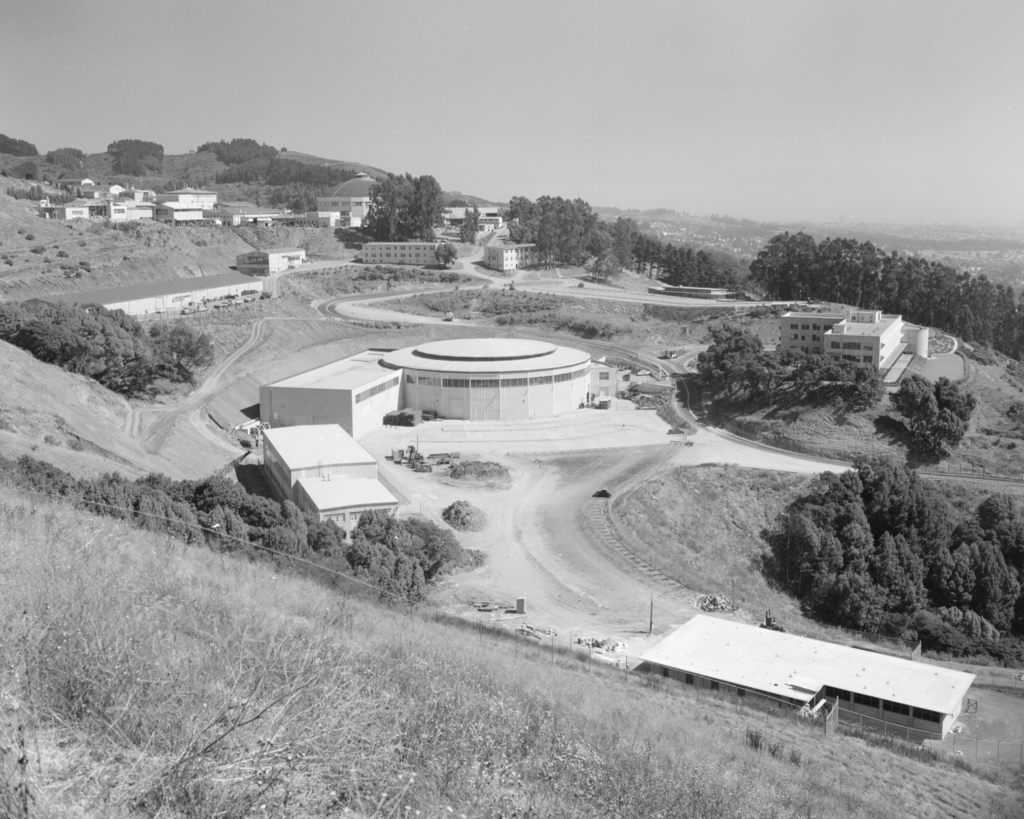
I just posted a review of Evelyn McDonnell’s The World According to Joan Didion on Goodreads. Wondering what image might serve to “illustrate” the review here, I thought of the centrality Didion claims for images in her very short essay, “Why I Write.”
In answer to the question of the title, she says she writes in order to gain any kind of access at all to her own mind, because she can’t think. It became clear when she was a student at the University of California Berkeley:
My attention veered inexorably back to the specific, to the tangible, to what was generally considered, by everyone I knew and for that matter have known since, the peripheral. I would try to contemplate the Hegelian dialectic and would find myself concentrating instead on a flowering pear tree outside my window…I would try to read linguistic theory and would find myself wondering instead if the lights were on in the bevatron up the hill. When I say that I was wondering if the lights were on in the bevatron, you might immediately suspect, if you deal in ideas at all, that I was registering the bevatron as a political symbol, thinking in shorthand about the military industrial complex and its role in the university community, but you would be wrong. I was only wondering if the lights were on in the bevatron, and how they looked. A physical fact.
When I read it, I didn’t know what a bevatron was, or why it was in Berkeley, or why that image might have been especially memorable to her. She guessed right about me reading that sentence, though: I assumed there would have been some symbolic meaning, and not “just” a nearby building she’d passed from time to time. It turns out a bevatron is an early particle accelerator (long since superseded), a research facility for particle physicists who, having successfully built an atomic bomb, turned their attention in the following decade to discovering how the universe came to be.
Maybe it takes a writer of Didion’s scape, depth, experience and, yes, authority, to push us past our common assumptions about writers, and maybe it’s a rare writer who can assess her own mental process with such clarity and confidence. But it’s a sobering reminder that raw perception comes before meaning of any kind, and may well be the most reliable route to discovery.


